Showing posts with label Reading Notes. Show all posts

Sunday, April 9, 2017

Reading Notes: Lang's European Fairy Tales I

These notes are from Lang's European Fairy Tales I unit. Story source: The Blue Fairy Book by Andrew Lang, illustrated by H. J. Ford (1889).

The Master Cat, or Puss in Boots
I have not read the original story of puss and boots, but I have seen the Puss in Boots from the Shrek movies. This is one of my favorite characters.
I think I would write a story in which I tell the history of how Puss in Boots came to be an adult. He would have grown up with a mother who was a seamstress. She fed him milk and spoiled him. Until one day she died, and Puss was all alone. What his mother didn't know was that he was teased in school a lot. And so he would wait after leaving the house to walk a different, more dangerous way to school because everything he usually walked with teased him. But after his mother died, he didn't know what to do anymore. He was so ashamed he hadn't told her that he was teased.
Fast forward 15 years, not in actual cat years, and he is all though. Thus the name, Puss in Boots.
Puss in boots. Source: Shrek. Wiki


The Dirty Shepherdess

I would change this story and make it two sons. It's always daughters who seem to be in a castle. For this story I would make it a father and his two sons. And the son that he kicks out isn't as smart or bright and intelligent as the other. The king doesn't think he can carry on the family name very well. So the youngest boy leaves and throws his crown on the dirt road as he leaves the castle. One into the poor village, he tries to find a job, but no one will give him one since they all know who he is. They remember him. He isn't very nice to them. When he comes to shop, he is rude and when he comes to eat, he never tips. So no one gives him a job.

Reading Notes: Italian Popular Tales, Part B

Reading Notes from Italian Popular Tales by Thomas Crane.

Reading Notes, Part B


The Language of Animals

Animals in a zoo. Source: Youtube
I would create a story in which a boy has been raised from birth in a zoo. His family are not gorillas. They are not monkeys. They are not anything you've heard before. They are giraffes. This boy can talk to the giraffes and his mother, Delila, has raised him as her own. This would be loosely based
off the reading but also off The Jungle Book. I would have everything be normal, until one night the zoo night guard comes by and thinks someone is trying to steal the animals, meanwhile is only the boy. They have never been caught before this. The boy runs away and hides as best he can, but because he doesn't understand how the real world works, he hides in a cage. The night guard calls the police and an entire investigation is started. The boy is scared. So he escapes as soon as he can with the help of his mother and her long neck. The boy runs as far away as he can. Then I would start to base the story off Elf, where he discovers the city and the fascinating things it has to offer him.

The Sexton's Nose

I would write a story about how a young man found a hundred dollar bill on the floor and had a small idea that he had been dreaming of every since he was small. He took the hundred dollar bill and invested it by gambling. He scored big. What can he say? He had great luck. He takes all his winnings, because where he lived and in the age he was in, he was allowed to gamble. So he takes all the money and becomes a millionaire by the time he is 22. But he doesn't live a normal life. He never grew up understanding how normal people live. He didn't understand the struggle. Story to be continued...


Reading Notes: Italian Popular Tales, Part A

Reading Notes from Italian Popular Tales by Thomas Crane.

Reading Notes, Part A

Zelinda and the Monster

This story reminds me of Psyche and Cupid because there are three sisters, two of whom are jealous of their sister. I think I would set this story in Mexico. There would be three triplet brothers and each of them would be married with kids. But they still live off daddy's money and none of them know how to work or the value of a dollar. So the boys are trying to raise their own kids but don't know how because they were never forced to understand.
One day the monster comes by all three boys' house. In this case, the monster is not an actual monster but a dealer. He is a liar. But he tricks people into thinking that they can play card tricks with him and if they win he will pay them money. Their wives tell their husbands not to give in and play this dirty game. But the first born man (only by 5 minutes) can't stand to say no. So he tells the monster that he will play one game, but that's it. Story to be continued.

The Fair Angiola

The Little Mermaid. Source: Giphy
Wow. Seven women in the original story. I would make them sisters. I would also have this story take place under the sea, like the little mermaid. Instead of a desire for jujubees, I would write about their desire for sea shells. But it's hard to find big round beautiful sea shells because they can't be found in their part of the reef. So some of them venture out to find them, but their father tells them it is too dangerous. The girls don't understand why they can't go beyond the reed, kind of like in Moana, and so Petria goes out one day past the reef, only to be caught in a fishing net. But thankfully a dolphin sees Petria and cuts her loose from the net of fish that is going up toward the fishing boat. Story to be continued. 

Reading Notes: Alice In Wonderland, Part B

Reading Notes from Lewis Carroll's Alice's Adventures in Wonderland, British/Celtic Unit.

Reading Part B:

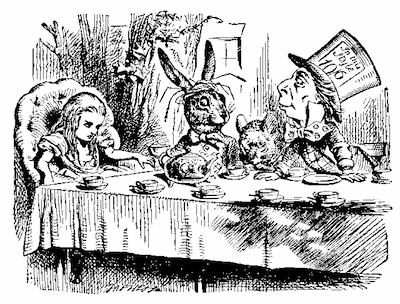
A Mad Tea Party

illustration by Sir John Tensile


I think instead of a table on the ground here in this story, there would be a table in a tree house. The rabbit goes up the tree into a tree house. Alice must figure out how to get up there since she is still sort of dazed by the caterpillar's candy. As the rabbit disappears out of eye sight, Alice sees a nearby river. She goes over to it to drink water. She feels much better. As she feels better minute by minute, she figures out a way to climb up the tall tree to get to where the rabbit has gone. She can hear voices, but doesn't know what's going on. As she is so curious, she finds a branch and uses it to propel herself up into the tree. She accidentally sticks a rough landing, and lands on top of the table. The Mad Hatter, which in this case will be a fox, is not happy. He leans over to eat Alice right up until the rabbit stops her. He says, "Wait!" We mustn't. She is important later on today. 
Then he gets up and scurries out of the tree house screaming, "I'm late, I'm late, for a very important date!" 
The rabbit disappears again out of Alice's sight. She must follow him. 


The Queen's Croquet-Ground

I think instead of the Queen of Hearts, she will be called the queen of diamonds. Why? Because what woman doesn't love diamonds. I understand that the original queen can control others' hearts and it is a source of power, but what about a queen of diamonds? I think she would rule over a land of diamonds and her servants are called diamonds in the rough. Ha! But anywhere, instead of roses being in the garden, too, there would be flowers that shine as much as a diamond would. The queen also kills the enemies and the ones who get in trouble with diamonds. 

Reading Notes: Alice in Wonderland, Part A

Reading Notes from Lewis Carroll's Alice's Adventures in Wonderland, British/Celtic Unit. 

Reading Part A: 

Down the Rabbit-Hole

I think I would have a parent reading a story to the little girl named Alice. I don't think they way this story opens is all that appealing. I would make the child of a younger age as well with a vivid imagination. The story would include the rabbit that was talking and saying he was going to be late. 
I think I would write a story kind of resembling Beauty and the Beast. Where whatever Alice runs into — supposedly intimate objects at first — they will talk back to her telling her she shouldn't be as curious as she is. 
The bottle she finds would say 'Don't Drink Me,' because we all know that children are notorious for doing the opposite of what they're told to do or not do. After Alice drinks it, she begins to speak in different languages. This is where the story would start to really differ from the original Alice in Wonderland stories. 


Advice from a Caterpillar

illustration by Sir John Tenniel
The caterpillar can talk, but he doesn't smoke. Instead he talks and if starts talking very emotionally, candy starts falling from his eyes. I would take the idea from the movie Inside Out. As he talks, he gets emotional and then candy starts coming out of his eyes. Alice wants to eat all of it. When she does though she starts laughing. The candy has magical powers in it that make anyone happy and laugh. But it also makes people unaware of what is going on around them. So the caterpillar knowing Alice is under the influence of the eye candy, tries to lure her into his cave so that he can eat her. But when that happens, the rabbits comes by and snaps Alice out of her trance but still says that he's late for a very important date. 

Reading Notes: English Fairy Tales, Part B

This story is part of the English Fairy Tales (1) unit. Story source: English Fairy Tales by Joseph Jacobs with illustrations by John D. Batten (1890).

Reading Notes, Part B:

Henny-Penny
This story is extremely interesting. I found it difficult to read because of the different punctuation used throughout. The dashes and the names within single quotes was confusing. Also, I know these are fairy tales, but the names are crazy. The long, rhyming names make it confusing to follow along. I wouldn't want to read these fairy tales to my children.

Molly Whuppie
After reading quote a few of these stories from the British unit, I have come to realize that I wouldn't have enjoyed these stories growing up. Or maybe I would have, but something about them isn't the same as the stories that I grew up with. This story here is not morally OK. I wouldn't read stories to my children about leaving children in the woods. That's called neglect. And I don't think it's humorous either. Then again, I don't find The Office to be funny either.
The giant in this story is quite interesting though. This story is confusing as well. Too many characters for me even to focus on rewriting this stories.

Mr. Fox
OK. This story is more creepy than any of the British stories that I've read. It started out sweet and what seemed to be a love story, but it is not. The story goes on and talks about blood and skeletons and I got so freaked out that I stopped reading halfway through. These aren't fairy tales. It makes sense, I think, because the British never seemed to be much of the fairy tale type.

Johnny-Cake

This is a story that I like. It reminds me of a gingerbread man and how he popped out of the over. I like the name for this one because he was baked and he probably is a cake. This story makes sense to me. This is a story that I could see reading to my kids.

Source: OU Blog Spot


Tuesday, April 4, 2017

Reading Notes: English Fairy Tales, Part A

This story is part of the English Fairy Tales (1) unit. Story source: English Fairy Tales by Joseph Jacobs with illustrations by John D. Batten (1890).

Reading Notes, Part A:

Tom Tit Tot

For this story, I would set the location in Italy. I would have the father wishing that someone would come by and take his daughter's hand in marriage. One day, he is out in the garden and he is singing a lovely tune about his daughter. A man walks by and inquires about who the song is about. When the father tells him, the man wants to marry this girl at once. The father only assumes that because the man is dressed well that he is the prince everyone has been talking about for days. The village said he would visit. So the man says that he will marry his daughter and give her everything she needs for 364 days of the year. But on the 365th day, she must make dinner for him and his friends to their liking. If she does not listen to him on this day or make food to their liking, he will kill her that night. It seemed like an easy task. So the daughter marries the man, but she finds out that he is not a prince, but a businessman who happened to be traveling through the village on business. When the daughter tells the father that the man is no prince, the man gets upset. He tells the girl that the deal is off. He tells the daughter that he will return her if she does not cook and clean for 364 days of the year. 

Source: Shutterstock

She can have one day off. Horrified, she does as she is told. She pretends to be the perfect wife when the friends come over and when other people visit. But deep down she is sad. Finally her father comes to visit her, and he can see in his daughter's eyes that she is not happy. So he plans a getaway for his daughter in the night.

The rest is history.

Note: I don't like the british fairy tales. They are too blunt and too scary.

Wednesday, March 29, 2017

Reading Notes: Native American Marriage Tales, Reading A

This story is part of the Native American Marriage Tales unit. Story source: Tales of the North American Indians by Stith Thompson (1929).


The Girl and the Turkeys:
Using a couple of main ideas from this story I would have a tribe that was very rich and enjoyed all the luxuries that nature and life had to offer them, but unlike others, as long as they had more money and fortune than everyone else then one of their sons and daughters had to marry animals. Of course, there was no reproducing with an animal and a human, it was just a pure marriage and the human would take care of the animal as a pet. But they could be married to another human. It was a sign of good luck, but the rich tribe didn't feel like this was something the rich would be forced to do by the sky, clouds and sun above them that ruled over them. Well one day, one of the daughters was set to marry a cow, but was not happy about it. She didn't understand why she must marry a cow. So she talked to the clouds. The clouds answered back to her in a way no one else could have understood. The next day, when she was set to marry the cow, as the entire tribe was gathered, instead of getting married she removed herself from the tribe and told them she didn't want to be rich anymore. That she would rather be poor and more unfortunate than marry a cow. She realized that having money wasn't what life was about and wasn't worth sacrificing a good, meaningful life with other people. Having to marry an animals was absurd. 

Source: The Huffington Post

Wednesday, March 22, 2017

Reading Notes, American Indian Fairy Tales, Part A

American Indian Fairy Tales

Notes, Part A

Shin-ge-bis Fools the North Wind

I would write a story about how the winds were brothers and they would laugh and cry and fight, and when that would happen, it would control the weather due to the brothers being different winds. Well one day they get in a huge fight and it causes a storm bigger than any other the tribe and its fishermen have seen. So the storm raged on and on. After a week, the people didn't know what to do. So they prayed to the winds and instead of a rain dance, they did a wind dance. The brothers still didn't care that the people were being affected. They cared more that each of them weren't going to give in then they did about helping the people. So the people decided to rebuild their village to fit the harsh winds and storms that continued to come. Then the brothers finally saw the damage they were causing, and decided to stop the fight for the good of the people. The people did one last wind dance, and the winds and storms finally stopped. They were so happy.


The Little Boy and Girl in the Cloud

I would make the fire tell the stories. Through the storyteller, though. I would write about how the people would build a fire for storytime, and once the flame was big enough a story would appear from the fire and be told through the storyteller. Or I could write about how the native peoples used clouds to tell stories and at the end of each story would predict something about the next day. But to get the clouds to tell a story, the native peoples must correctly chant toward them and request a story.


Butterflies. Source: PBS


This story is part of the American Indian Fairy Tales unit. Story source: American Indian Fairy Tales by W.T. Larned, with illustrations by John Rae (1921).

Tuesday, February 28, 2017

Reading Notes: Filipino Popular Tales, Part A


The Three Friends: the Monkey, the Dog, and the Carabao

Honestly, I didn't read this story because I have a slight phobia of snakes. So when I saw the photo, I immediately clicked to the next story.

 
Three Brothers of Fortune

I think the boys should be homeschooled and the boys should be triplet girls of the age of 12. I might make the book, the mat and the stone different objects. This story seems to be genie like in a sense, and I think I would make the story more practical and use objects that could actually fix things. There wouldn't be a woman dying, but instead a woman almost drowning and the girls have to figure out how to save her with the three tools each of them has. But they three girls are so spoiled rotten and don't think for themselves that the woman almost drowns because it takes forever for the girls to figure out what they should do. The story would continue on to that the woman says she owes the girls, but can only pay one, give food to the other and give books to the last. The girls don't want any of it.
The Clever Husband and Wife

I honestly would not make this a happy ending. I would make it so that the husband and his wife learned a valuable lesson about money and faking death and lying. 

 
The Devil and the Guachinango

I would change the end so that the devil died once all the bells were rung. I think the princess shouldn't have married the guachinango at all. She should marry a poor boy, whom I would add in as a character. She would fall in love with the poor boy, but instead have to be forced to marry the guachinango because of the devil. When the guachinango sees that the princess isn't in love with him but instead, the poor boy, he would try to back down, but the devil would insist that he stay and finish what he started. 

Church bells. Source: Imagejournal.org

Bibliography: These stories come from Dean Fansler's monumental Filipino Popular Tales, published in 1921.


Note: All of these stories are well-thought out, but the endings seem abrupt and too positive. I would definitely change my own story to make a lesson out of the characters that are negative or evil. 

Tuesday, February 14, 2017

Reading Notes: The Arabian Nights' Entertainments, Part A

Notes from: The Arabian Nights' Entertainments


READING A:
Scheherazade
I think for this story I might change it from the Sultan just having the women killed to having the women perform a magic trick or show for him each morning, and if he didn't like it, then the wife would die. If he did like it, she had another day to live. 
Then I would change Scheherazade's original idea to think up of a magic trick that transported the Sultan to a different time period or something where he couldn't kill any more wives or Scheherazade herself.


The Story of the Merchant and the Genius 
Scheherazade continues doing her magic trick and making the Sultan think he is in a different time period and place and he enjoys what it has to offer him so much that he doesn't think of killing her because he still thinks it is a magic show. When really, Scheherazade and her father have drugged the Sultan and flown him indeed to another country where he is living. The Sultan never figures it out, but gets upset with Scheherazade so she must drug him again to fly him back to his home. When he gets there, he plans to kill her, but Scheherazade stops him again and tells him she has one more magic trick. Her magic trick is she disappears and takes all the women with her outside the village. The Sultan can no longer take from the land he has power over. 

The Story of the First Old Man and of the Hind
The Story of the Second Old Man, and of the Two Black Dogs
The Story of the Fisherman
The Story of the Greek King and the Physician Douban
The Story of the Parrot; The Story of the Ogress
The Story of the Physician's Revenge
The Story of the Sultan and the Fish
The Story of the Young King of the Black Isles
A genie that I would image in a story. Source: funnyfactsss

After reading these stories that Scheherazade is telling, I feel I could make up any tale that was intriguing. I think I would base my story loosely based off The Story of the Merchant and the Genius as well as Aladdin. There would be a genie who granted wishes, but every wish granted the grantee would realize that what he asked for wasn't really what he wanted.


Bibliography: UNtextbook, India Unit, Arabian Nights

Tuesday, February 7, 2017

Reading Notes: Fables of Bidpai, Part A

Fables of Bidpai by Maude Dutton: The Tortoise and the Geese and Other Fables of Bidpai.

Notes:

READING A:

The Rustic and the Nightingale
I think I would write this story in first person, detailing the bird and what it was doing. I would give the bird dialogue as well. I wouldn't write as much dialogue, as right now it is too long.
The King, the Falcon, and the Drinking-Cup
For this kind of story, I would make the animals talk to the king in a way that the others cannot hear. The people he is with will think he has gone crazy. The king doesn't want people to think he has gone crazy so even though the animals are talking to him and he finally has sympathy for him, he decided to shoot and kill the next bird he sees. His friends think him brave and strong. The animals he can talk to are now upset and don't understand why he would do such a cruel thing. The king apologizes to the animals around him and to the bird's family of who he has shot. But all of a sudden the king's friend goes to shoot another bird but accidentally trips on a branch right as he released the trigger and he shoots and kills the king. 

Falcon in the air. Source: Wikimedia Commons


All of the men run away because they are scared and they also know they need to run to get help. As the men disappear from the crime scene, the limp king's body lay still. All of a sudden, the body is lifted into the air and transformed into a bird. Just like the one he shot. He lives the rest of his life as a bird trying to survive in the wilderness and change the minds of hunters who just hunt for sport as he did. 
I would write a story about the water and how it heals, protects, or harms if you displease it. The water commands its visitors to perform tasks and to report back to it in return for one life-changing favor. Someone wishes for the king to die. What happens next to the wisher isn't good. 

Note: I read through the other stories, but none of them spoke to me in creativity as the the Drinking Cup story. This is what I will write about for my story for week 4. 


Monday, January 30, 2017

Reading Notes: The Aesop for Children, Part A

My ideas and notes from Reading Part A:


The Wolf and the Kid & The Tortoise and the Ducks:

Instead of ducks, I would make them eagles, and instead of a tortoise, I would make it a sloth. The story would take place from a zoo, and the sloth would be in the zoo and unable to visit places, including his best friend’s wedding that he so wanted to go to, he was just too slow, and honestly, too lazy. So he gets help from the eagles, but just as he passes the lions cage, the lions say out loud that the sloth must be the Chosen One! Just as the sloth agrees, the eagles drop him in the cage. This would be part 1 of the story teaching the lesson that you must not live in vain, especially when someone is helping you. The second part of the story would be based on The Wolf and the Kid, where the lions are going to eat the sloth, but the sloth convinces the lions to wait because the sloth can entertain them by doing magic tricks. The lions have never seen magic tricks, and so they agree. The sloth makes a deal that if the lions are impressed, they cannot eat him. But if they are not impressed, they can proceed. The sloth does several tricks that last into the night. The lions are somewhat pleased, but as they near the sloth to eat him after his last trick, the sloth disappears. This is the sloth’s famous and last trick: disappearance.


The Boy and the Filberts:
Once there was a poor, poor village just outside the kingdom’s reach, and every morning the baker would put out a basket of burnt bread for the children to get on their way to school. One day, the prince, just 7 years old, had found himself escaped from his palace keeper, and ventured by this bread basket and the children who seemed so delighted in it. The boy wanted to join these kids, for he never got play with children his age, he was always stuck in the palace, bored as ever. So he ventured over to the bread basket and the children, and the poorer children looked at him and told him to go away. They could tell by the prince’s clothing that they weren’t like him. But the children grabbed as much as their hands could hold, and then the prince put his hand in the basket and grabbed as much as he could, but his hand would not come out of the basket. The longer he kept his hand in the basket, the more his hand kept bending.

Baskets of bread. Source: Wikimedia Commons


He started to cry out, and the children who hadn’t made it very far, turned around to look. Some came back to him, and told him to let go of some of the bread and take only what he could eat. The prince immediately let go of the majority of the bread, and only picked up what he could eat. His hand was free and his belly was full. The lesson? Those who are fortunate should only take what they need and leave the rest for those who are not as fortunate.


These stories are part of the Aesop (Winter) unit. Story source: The Aesop for Children, with illustrations by Milo Winter (1919).


Sunday, January 29, 2017

Reading Notes: Apuleius's Cupid and Psyche, Part B

Notes:

Venus and the Goddesses:
When Venus is mad I think she should turn into a large sea-like serpent.

Venus and Psyche:
I would change the punishment to making Psyche eat a bunch of food, basically force feeding her instead of flogging her. I think Psyche should be pregnant as well, and Venus would not be able to torture her but to cast a spell on her unborn child to get back at Cupid and her daughter-in-law.
I think Cupid would then come in and stop his mother from torturing his wife so, and then Cupid would use his powers to chain his mother up for eternity.

Psyche’s Task:
I think instead of sheep’s wool Psyche was required to get, I think it should be she must learn how to talk to silk worms on a tree to get them to make her enough silk to make a dress for Venus’s ball. Unfortunately, she is unable to speak to the worms, does not get enough silk and can only make a headband out of the silk she does have. So Psyche is tortured again, but this time goes to bed without food.

The Jar of Beauty:
I think in the jar of beauty will be all of Venus’ secrets and her form, and Psyche will accidentally drop the jar and inherit all of Venus’ power from that moment on. But the catch is that Psyche can no longer be with Cupid, and Venus must live without him even though she is having his baby. So Cupid and Psyche are still unable to be together and raise a child together.

The Escape:
The donkey doesn’t just escape from his chains, but bites and kills all the robbers to save the princess. But before the donkey and princess escape, the old lady casts a spell on the girl now. When she marries, her first born will turn into a donkey unless met by a kind owner who feeds his barley.
The donkey from Cupid and Psyche, The Golden Ass by Apuleius.
Source: Calvary Chapel Birmingham


Bibliography:
Cupid and Psyche by Apuleius

Monday, January 23, 2017

Reading Notes: Apuleius's Cupid and Psyche, Part A

Notes:

Chapter: Captive Woman
- After they kidnap the woman, the bandits tell her not to fear for her life and to understand they just want money. I could change this part to have the bandits make fun of her lifestyle and how it is so easy and come to find out, the woman has a rougher life than some of the bandits, who then sit down next to her and relate to her. Of course, they still keep her captive. 

Chapter: Her Dream
- Instead of a cousin to who she was supposed to marry, I would change it to a little orphan boy who the family took in and raised to be a servant in the castle. The woman has fallen in love with him, and we find out later that the king and queen had planned for the boy to be kidnapped, but the head bandit got so greedy that instead of kidnapping the boy so the woman couldn't marry him, they kidnapped the woman (a princess instead) to get more money. 

Chapter: Psyche's Beauty
- Instead of the youngest girl being born from the sea, I would say she was born from a volcano. 

Psyche would be born from a beautiful volcano instead of the sea.
Photo: Flickr

Chapter: Fears and Doubts
- High on a mountain crag, decked in her finery,
Lead your daughter, King, to her fatal marriage.
And hope for no child of hers born of a mortal,
But a cruel and savage, serpent-like winged evil,
Flying through the heavens and threatening all,
Menacing ever soul on earth with fire and sword,
Till Jove himself trembles, the gods are terrified,
And rivers quake and the Stygian shades beside.

General thoughts near the end of reading Part A:
- Instead of cupid being invisible I would make him ugly, and right as Psyche holds the knife to kill her husband, he would immediately turn into the handsome god that he was, but it would be too late, because the other gods would force the knife in cupid's beautiful face and he would be wounded but handsome for eternity. 

Bibliography:
Cupid and Psyche by Apuleius